Bud
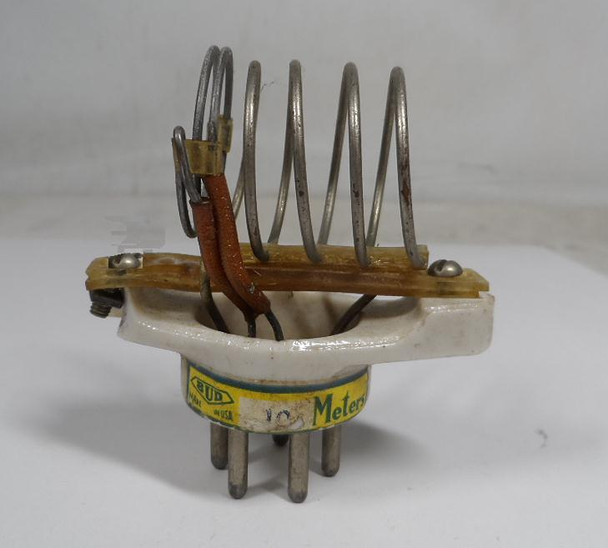
Bud 10 Meter with Adjustable End Link Oscillator and Buffer Coil in Good Condition
- Condition:
- Used
- Shipping:
- Free Shipping

Frequently bought together:
Description
Bud 10 Meter with Adjustable End Link Oscillator and Buffer Coil in Good Condition.
The left side ceramic is cracked away near the mounting screw but the coil is still solid
**Free Shipping in the USA**
The Bud OCL Series is a vintage line of plug-in oscillator and buffer coils from Bud Radio Inc. (Cleveland, Ohio), dating to the late 1930s–1950s era. These were part of Bud's O-series inductors for amateur radio (ham) transmitters, designed for oscillator (crystal/VFO) and buffer (isolation/doubler) stages in low-to-medium power HF setups.The "OCL" stands for Oscillator Center-Linked (fixed link at the center of the main coil, with the main winding center-tapped). This configuration was ideal for balanced circuits, push-pull stages, or certain tube types requiring center-tapping for symmetry, neutralization, or even harmonic suppression (contrast with OEL = end-linked/no tap, OLS = adjustable/swinging center link, OCP = pentode-specific fixed link, OES = adjustable/swinging end link).Key Specifications
- Power Handling: Rated for 50 watts input in early catalogs (e.g., Bud Parts Catalog No. 140, 1939), though some later/surviving examples (e.g., OCL-20) are labeled or sold as 75 watts (likely minor design updates or conservative derating for oscillator/buffer use in CW/low-duty modes—derate further for phone/AM).
- Construction: Air-wound tinned copper wire on a glazed ceramic base/form with banana plugs (fits standard 5-prong tube sockets). Fixed center link for inductive coupling to antenna/grid circuits; windings cemented on acetate locking strips for stability; base elevates coil from chassis to minimize stray capacitance and losses.
- Purpose: Band-switching in multi-band low-power transmitters (e.g., exciter stages). High Q for efficiency; plug-in for quick band changes in homebrew, kit, or commercial rigs.
- Tuning Data (from 1939 Bud catalog; approximate total capacitance needed to resonate at band low end with typical variable capacitor):
- Higher bands need lower capacitance due to smaller inductance.
- OCL-160 — 160-meter band (1.8–2.0 MHz); ~90 mmfd capacity.
- OCL-80 — 80-meter band (3.5–4.0 MHz); ~75 mmfd capacity.
- OCL-40 — 40-meter band (7.0–7.3 MHz); ~50 mmfd capacity (common survivor).
- OCL-20 — 20-meter band (14 MHz); ~33 mmfd capacity (frequently listed as 75W variant).
- OCL-10 — 10-meter band (28–29.7 MHz); ~28 mmfd capacity.
- OCL-5 — 5-meter band (VHF, ~50–54 MHz era); ~18 mmfd capacity (rarer).
**Free Shipping in the USA**
This coil is in great shape. The Cross support material has a split in it but it is solid and does not move and is not deteriorating.
The Bud OES Series is a vintage line of plug-in oscillator and buffer coils from Bud Radio Inc. (Cleveland, Ohio), produced in the 1940s–1950s for amateur radio (ham) transmitters. These coils were part of Bud's O-series inductors, optimized for oscillator (crystal/VFO stages) and buffer (isolation/doubler) applications in low-to-medium power HF setups.The "OES" designation likely stands for Oscillator End-linked Swinging (or similar adjustable end-link variant), featuring an adjustable/swinging link at one end for variable coupling and impedance matching (unlike fixed-link OEL/OCP or center-linked OCL/OLS types). They were built on glazed ceramic bases with banana plugs (fitting standard 5-prong tube sockets), air-wound tinned copper windings, and high-Q design for efficiency.Key Specifications
- Power Handling: Rated for 75 watts input (conservative for oscillator/buffer stages; suitable for CW or low-duty modulated use—derate for phone/AM to prevent overheating).
- Construction: Fixed or adjustable end link (swinging for fine loading control); main winding typically not center-tapped (suited for pentode/triode configs); cemented windings on acetate strips for stability; compact form to minimize chassis interaction.
- Purpose: Band-switching in multi-band low-power transmitters (e.g., homebrew CW rigs, exciter stages before final amps). The adjustable link allows dynamic tuning of coupling to antenna/grid circuits, reducing harmonics and optimizing power transfer.
- OES-160 (or OES-160-A) — For 160-meter band (1.8–2.0 MHz). Documented example with suspended coupling link on lead wires; rated 75W; ceramic base with 5-pin US plug; dimensions approx. 69 x 85 x 45 mm.
- Other likely/probable variants (based on patterns in Bud's O-series like OEL/OCL/OLS/OCP):
- OES-80 for 80-meter band (3.5–4.0 MHz).
- OES-40 for 40-meter band (7.0–7.3 MHz).
- OES-20 for 20-meter band (14 MHz).
- OES-10 for 10-meter band (28–29.7 MHz).
- Possibly OES-15 or others for WARC/higher bands, though rarer.
Related Products
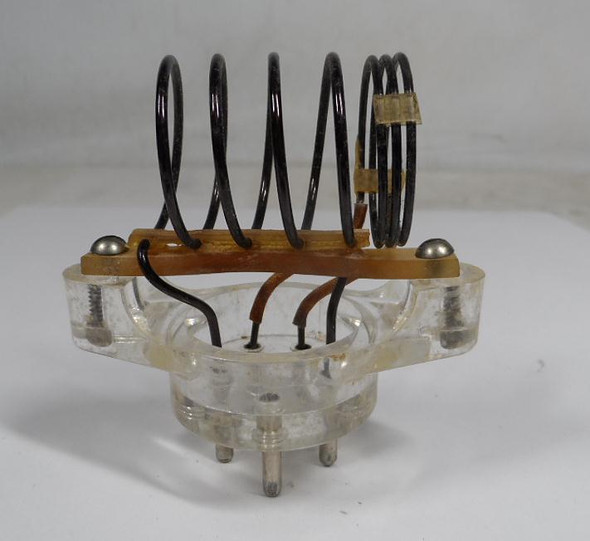

Bud OES-20, 20 Meter 75 Watt Oscillator and Buffer Coil in Very Good Condition #1
Bud
$29.99
Bud OES-20, 20 Meter 75 Watt Oscillator and Buffer Coil in Very Good Condition #1
**Free Shipping in the USA**
This coil is in great shape. The Cross support material has a split in it but it...
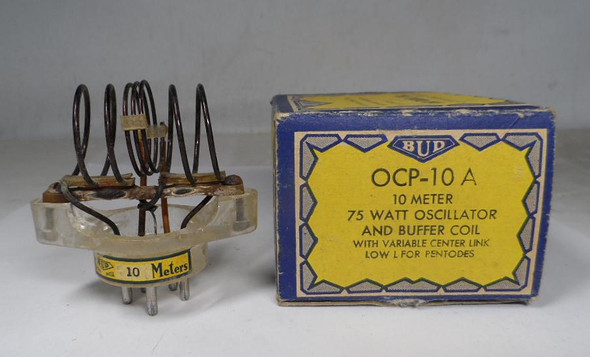
Bud OCP-10A, 10 Meter 75 Watt Oscillator and Buffer Coils in Excellent Condition in Box #1
Bud
$24.99
Bud OCP-10A, 10 Meter 75 Watt Oscillator and Buffer Coils in Excellent Condition in Box #1
**Free Shipping in the USA**
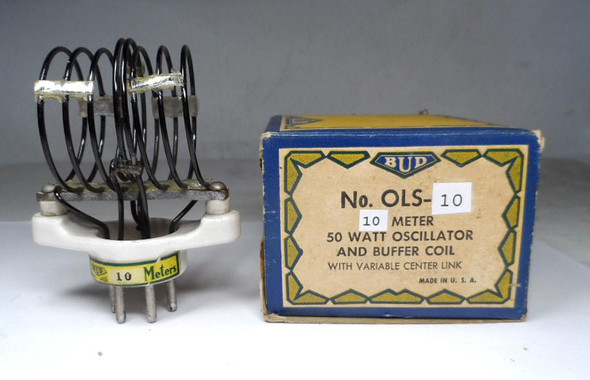
Bud OLS-10, 10 Meter 50 Watt Oscillator and Buffer Coils NOS #1
Bud
$34.99
Bud OLS-10, 10 Meter 50 Watt Oscillator and Buffer Coils NOS #1
**Free Shipping in the USA**

Bud OEL-10, 10 Meter 50 Watt Oscillator and Buffer Coil Used #2
Bud
$24.99
Bud OEL-10, 10 Meter 50 Watt Oscillator and Buffer Coil Used #2
**Free Shipping in the USA**
The Bud OEL Series